The question usually shows up with a photo attached. Two flags lie on a kitchen table, one with stitched stars you can see catching the light and one that looks flat, and the sender wants to know if the stitched one is worth it. We make both kinds of Made in USA flags, so we get to answer the embroidered vs printed American flag question from the sewing side. Our short answer depends on how close people stand to your flag.
TL;DR: An embroidered flag builds its face with thread. Its stars are stitched and its stripes are sewn from separate strips. A printed flag carries the whole design on one piece of fabric. We pick embroidered for a flag that flies outside daily at eye level. We pick printed for classrooms and walls. Under the law, both are the flag.
Quick pick
- Flying outside every day: Durable Patriot, high-grade nylon with embroidered stars and sewn stripes, sizes 2x3 to 12x18
- Classroom or wall: our printed poly-cotton 3x5 flag, 70% polyester and 30% cotton
How an Embroidered vs Printed American Flag Is Built
On an embroidered flag, the 13 stripes start as separate strips of red and white fabric that get sewn into one body. The blue field is usually its own panel. The stars are stitched onto that blue with white thread, so each one is a small raised patch you can feel with a thumb. A printed flag starts as one sheet. Every color goes onto that sheet in one process, and the surface stays smooth. We make both kinds, and we would not sell a printed flag we were embarrassed by.
The Flag Code does not care which way a flag was made. 4 U.S.C. § 1 defines the flag as "thirteen horizontal stripes, alternate red and white" with white stars in a blue field. Executive Order 10834 sits in the notes on that page and sets the proportions and star positions. Neither says a word about thread or ink. We find that reassuring when someone worries a printed flag is somehow less proper.
It is not.
Embroidered Stars vs Printed Stars, Up Close
Stars are where we look first, because that is where the two methods part ways. On a typical printed flag the white of each star is the cloth itself, left bare while the blue goes on around it. So a printed star is only as sharp as the blue that outlines it. When the blue softens in the sun, the edges of the stars soften with it.
An embroidered star is built on top of the blue from white thread. Run a finger over the canton of our Durable Patriot and you feel 50 small ridges. That texture throws tiny shadows, so the stars read as raised when you stand close. We will admit the effect fades with distance. Past the end of a driveway, most eyes cannot tell a stitched star from a printed one.
Up close, the thread wins.
Sewn Stripes vs Printed Stripes
Sewn stripes are separate strips of colored fabric joined by seams. That gives the flag a line of stitching between every red and white band, and it means each color is dyed into its own cloth. Printed stripes sit side by side on one sheet with no seam between them. We like the look of seams on a flag in the wind. They add a little structure and catch light the way the stars do.
Both of our embroidered lines use sewn stripes. The Durable Patriot is high-grade nylon with embroidered stars and sewn stripes. Our Everlast American Pride uses the same construction on 2-ply spun polyester, which has a canvas-like look. Our printed flag is a 70/30 poly-cotton 3x5, and its stripes are part of the printed design.
Side by Side: Our Embroidered and Printed Flags
| Embroidered stars and sewn stripes | Printed design | |
|---|---|---|
| How the face is made | Stars stitched in thread on a separate blue panel; stripes sewn from strips | Whole design applied to one sheet of fabric |
| Up close | Raised stars and visible seams | Smooth and flat |
| From the street | Crisp | Hard to tell apart |
| When the blue fades | Thread stars keep their own white | Star edges soften with the blue |
| Where we use it | Porch or yard pole flown daily | Classroom or wall or sheltered spot |
| Our flags | Durable Patriot in nylon; Everlast American Pride in spun polyester | Poly-cotton 3x5 |
Where Each One Fits
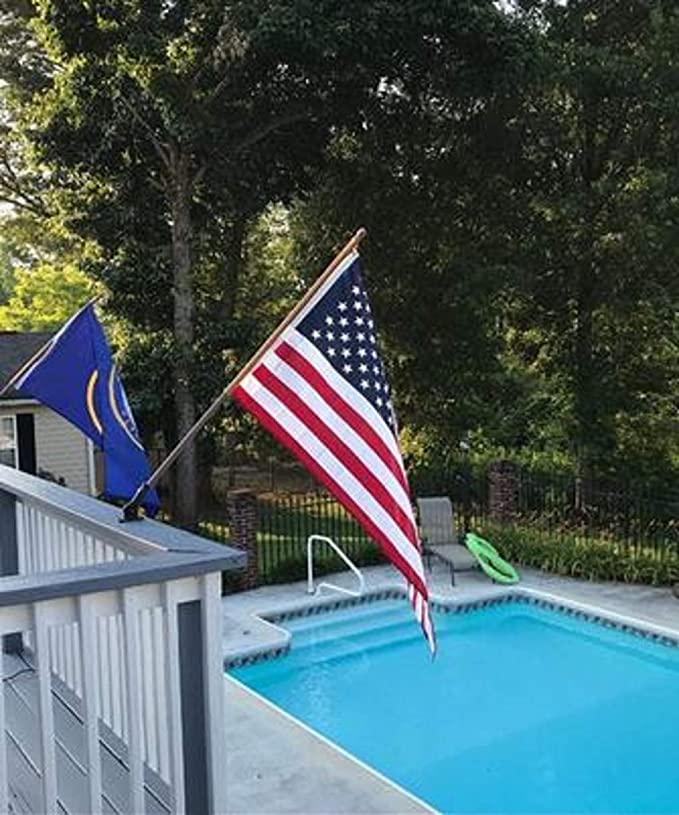
We sort it by distance and by hours in the weather. A flag on a house bracket next to the front door gets seen from two steps away by every guest, and the stitched stars earn their keep there. A flag that flies every day in a yard takes sun and wind for months on end, and we would rather have the colors built into thread and separate cloth than carried on one printed sheet. A classroom flag is a different job. It hangs still, it gets looked at from desks across the room, and it rarely sees rain. That is where our printed poly-cotton flag makes sense to us, and its listing names classrooms and walls among its uses. It flies outdoors too. The listing describes it as designed for light flyability. We would still put it on a sheltered porch before an open ridge.
If your yard sees steady wind, fabric matters more than the stars. Our nylon vs spun polyester guide covers that choice, and our high wind guide goes further for coastal and open lots.
What Embroidery Will Not Fix
A flag usually wears out at the fly end first, the edge that snaps in the wind. Embroidered stars do nothing for that edge. What protects it is the hem. The Durable Patriot and our printed poly-cotton flag share the same quadruple-stitched fly hem. They also share a reinforced polyester header with heavy-duty brass grommets. The Everlast gets a four-row stitched fly hem. So on our own shelf, the finishing is the same on our embroidered and printed flags.
The face and the fabric are what change.
We say this because we have seen beautifully stitched flags fray at the fly end after one windy season. Wind and daily hours on the pole decide a flag's life more than the stars do. Our post on how long an American flag lasts walks through the wear signs we check.
Is Embroidery Worth It?
For a flag that flies outside every day where people see it up close, we think yes. Embroidery takes more machine time and more thread than printing, and you can see where that work went every time you walk past the flag. For a classroom wall or a flag that comes out on a few holidays, a printed flag does the job with no apology needed. That is how we settle the embroidered vs printed American flag choice for our own porches.
Distance first, then weather.
Our guide to choosing a durable embroidered American flag goes deeper on nylon embroidery for outdoor use. You can see all three of our flags in our American flags collection.
Related from our blog: Nylon vs spun polyester American flags · How long does an American flag last · Best American flag for high wind
Questions About Embroidered vs Printed American Flags
How is an embroidered American flag made compared with a printed one?
The face is built differently. An embroidered flag has stars stitched in white thread on the blue field and stripes sewn together from strips of colored fabric. A printed flag carries the whole design on one sheet of cloth. We make both, and what you notice first is texture. One has raised stars and seams. The other is smooth.
Do printed flags fade faster than embroidered flags?
The colors on both will fade in strong sun over time. On a printed flag, the white stars are usually bare cloth outlined by the blue, so when the blue lightens the stars lose their sharp edge. Embroidered stars are their own white thread sitting on the blue, so they keep their outline longer. Fabric and hours outside matter more than the method.
Is a printed American flag disrespectful to fly?
No. The Flag Code describes the flag as thirteen red and white stripes with white stars on a blue field, and Executive Order 10834 sets its proportions. Neither mentions embroidery or printing. A printed flag in good condition that is flown with the usual care is the flag. We see no reason to treat an embroidered vs printed American flag differently on the pole.
How can I tell if a flag has embroidered stars?
Touch the blue field. Embroidered stars feel raised, and when you turn the flag over you can usually see stitching behind each star. Printed stars are flat and smooth, with no stitching around them on either side. Sewn stripes show a seam between each red and white band. In a product photo, zoom in on the stars and look for stitch lines.
Are sewn stripes better than printed stripes?
For a flag that flies outside every day, we prefer sewn stripes. Each color is its own strip of dyed fabric, and the seams give the body a bit of structure. Printed stripes are smooth and look clean indoors. The Durable Patriot and the Everlast American Pride both have sewn stripes. Our poly-cotton 3x5 has printed stripes.
What kind of flag is best for a classroom or indoor display?
For a classroom wall or an indoor stand, a printed flag works well. It hangs still and people see it from across a room. Our printed poly-cotton 3x5 is listed for classrooms and walls and can go outside too. If the flag will be handled often or shown up close in a frame, an embroidered flag shows off its stitching.
Sources
- U.S. Flag Code, 4 U.S.C. § 1 (flag; stripes and stars) with Executive Order 10834 (proportions and sizes of flags and position of stars; "thirteen horizontal stripes, alternate red and white, and a union consisting of white stars on a field of blue") in the statutory notes (Cornell LII, accessed Oct 30, 2026): https://www.law.cornell.edu/uscode/text/4/1
Share:
How to Dispose of American Flag Fabric, Including Nylon and Polyester Flags
Can You Fly American Flag in Rain, Snow or High Wind? All-Weather Flag Rules for Winter