Every spring we get the same question, often with a photo attached: is it time? Usually the stars are still crisp. On the side that faces the street, the red stripes have gone the soft pink of a pencil eraser, and the last few inches of the fly end have started to fringe. We make and sell Made in USA flags, and that photo sums up every question we get about when to replace American flags. We won't hand you a month count. We'll show you how we read a flag.
TL;DR: No law or official body sets a lifespan for an outdoor flag. The Flag Code's test is whether the flag is still a fitting emblem for display (4 U.S.C. § 8(k)). Wear starts at the fly end, and the red stripes tend to show fade first. Nylon flies in light air; spun polyester takes steady wind. We judge a flag against a fresh one from the same pack and retire it when fray runs into the stripes or the red reads pink from the curb.
What Wears First on an Outdoor Flag
The fly end goes first. That is the free edge farthest from the pole, and it snaps like the tip of a whip with every gust while the header side barely moves. On the flags we look at, the first sign is a single thread curling off the hem at the outer corner. Then the hem opens. Then the stripes start to pull apart at their seams, and the fray walks inward toward the stars. Contact speeds all of it up. A gutter edge or a branch that grew into the swing path will chew a flag faster than most storms. The Flag Code asks that the flag never touch anything beneath it (4 U.S.C. § 8(b)) and never be displayed in a way that lets it be easily torn or damaged (§ 8(e)). We read that second line as practical advice as much as etiquette.
The header wears too, just slower. It carries the pull from the grommets every hour the flag is up, and a soaked flag in wind loads it hard. Our Durable Patriot has a quadruple-stitched fly hem and heavy-duty brass grommets in a reinforced polyester header, because those two spots are where we see flags give out.
Check the hem before you check the color.
The Flag Code lets an all-weather flag stay up on bad days (4 U.S.C. § 6(c)). The American Legion adds that in the most extreme weather, even an all-weather flag will have difficulty standing up to high winds (American Legion). We still bring ours in when a big storm is on the way.
Why Does My Flag Fade?
Sun does most of it. Ultraviolet light breaks down dye over time, and no outdoor fabric escapes that. We see the red stripes go first, toward pink, while the blue holds on a little longer. A flag on a south or west wall fades sooner than one on a shaded porch, because it takes the hard afternoon sun. A flag that stays damp for days can pick up mildew on the white stripes, and road grime turns the whites gray. Hand washing in cool water with mild soap lifts some of that. Sun fade stays.
Which fabric fades faster depends on which page you read. The pages that put a number on it rarely show how they measured, so we don't name a winner.
How Long Do Outdoor Flags Last? Nylon vs Spun Polyester
Search that question and you get month counts for both fabrics. They disagree. One seller's guide and its own calculator page give different ranges for nylon. None of the pages we read cite a test. The Flag Code sets no lifespan, so we don't publish one. A flag wears by the hour, and how hard those hours are depends on your wind and your sun. What we can give you is how each fabric tends to wear.
| Wear factor | High-grade nylon | 2-ply spun polyester |
|---|---|---|
| What we watch first | Fly-end fray | Fly-end fray, plus the header under load |
| Wind | Flies in light air; a bare ridge wears the fly end | Heavier cloth for steady, strong wind |
| Wet weather | Durable Patriot colors shed water | Hangs heavier when soaked |
| Sun | Bright, slightly glossy color; fades in hard sun like any flag | Deeper, matte color; fades in hard sun like any flag |
| Site where it does best | Porch or sheltered yard | Open lot or coastal yard |
| Our flag | Durable Patriot | Everlast American Pride |
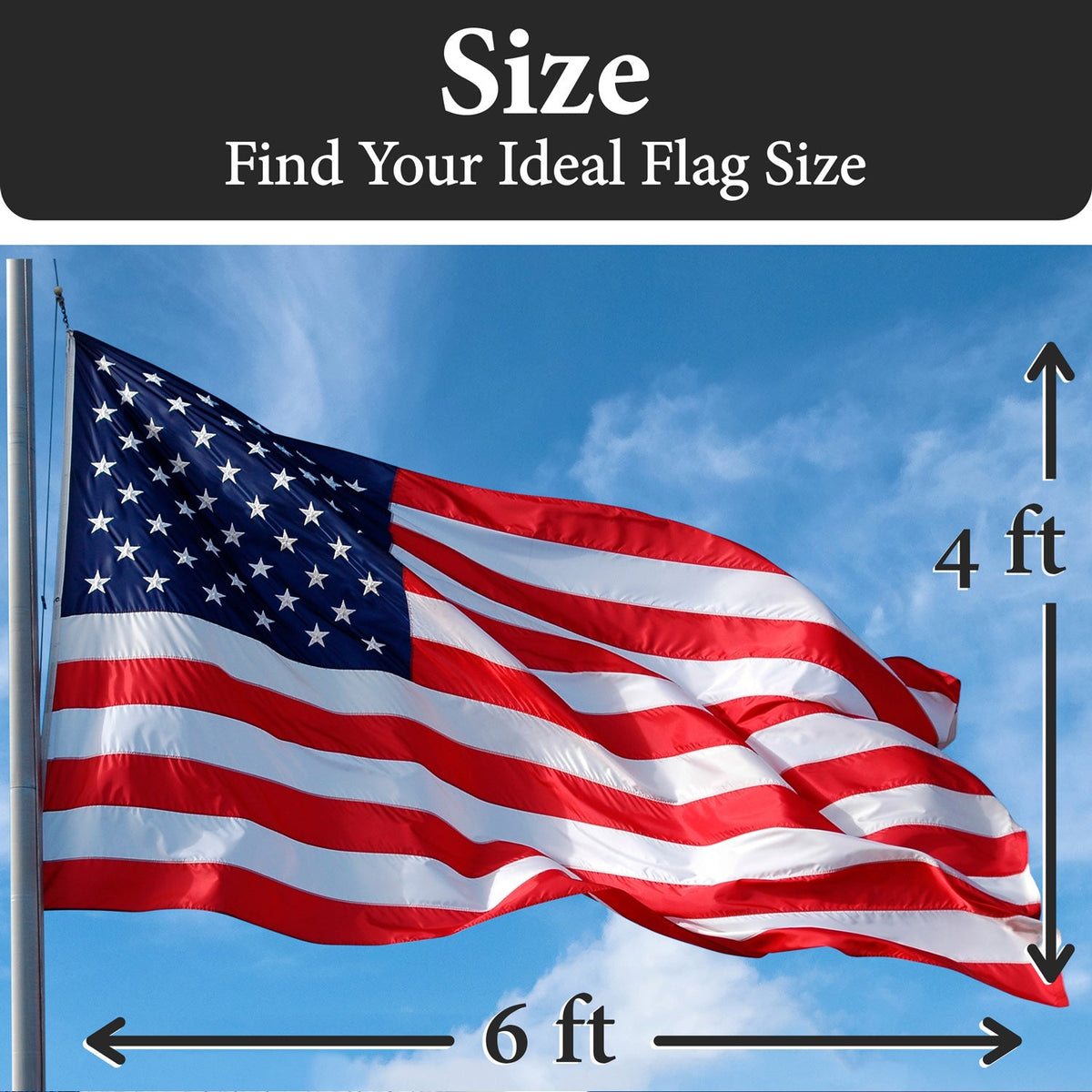
Size plays in too. A flag too big for its pole is a bigger sail, and the fly end pays for it. Our American flag size guide for a house has the pole chart, and our nylon vs spun polyester guide goes deeper on the fabric choice.
When to Replace American Flags: A Five-Point Porch Check
We run this check from the yard with a fresh flag from the same pack held up next to the old one. The spare is the reference. A flag fades so slowly that your eye adjusts, and after a while the pink starts to look red.
- Fly end. Run a thumb along the outer hem. A loose thread can be mended. Fray that runs past the hem into the stripes means it is time.
- Color from the curb. Walk to the street and hold the spare up. If the red reads pink or the blue looks gray beside it, retire the flag.
- Seams and stars. Look for stripes separating at the seams and embroidery thread lifting off the stars. If either is spreading, retire it.
- Header and grommets. A torn header or a grommet working loose means the next gust can rip the flag free.
- Stains. Mildew or grime that stays put after a gentle wash means it is time.
The American Legion keeps its line short: a flag that is tattered, ripped, torn or faded is unserviceable and should be replaced as soon as possible (American Legion). Mending is allowed. The Legion's flag FAQ says nothing in the Flag Code prohibits sewing or repairing a flag, with one caution: if material is removed, the flag may no longer match the proportions set in Executive Order 10834 (American Legion flag FAQ). We mend a loose hem the day we find it. We stop trimming a fly end that keeps coming back.
Hesitating at the curb usually means yes.
Why We Rotate a 3-Pack
Both of our main flags come in a pack of three, and rotation is the reason. Rotating won't make cloth tougher. Each flag still wears by the hour. What it does is spread those hours across three flags, so one rests folded in a drawer while another flies. It also leaves a dry spare ready after a storm or a wash. And the one still sealed in its bag is your color reference for the porch check.
Here is how we run it at home. Fly one. Keep one in the drawer and one sealed. Swap the first two when the seasons change or after a hard stretch of weather. When the first one fails the check, we retire it. The sealed one goes up. That is how we decide when to replace American flags on our own poles.
For a porch or a yard with light wind, we point people to the Durable Patriot 3x5 Pack of 3, high-grade nylon with embroidered stars and sewn stripes. For an open lot or a coastal home, it's the Everlast American Pride 3x5 Pack of 3 in 2-ply spun polyester, also with embroidered stars and sewn stripes. Our guide to the best American flag for high wind covers that second case in detail.
Retiring the Old One
When a flag fails the check, the Flag Code says it "should be destroyed in a dignified way, preferably by burning" (4 U.S.C. § 8(k)). Most flags today are nylon or polyester. The Legion's FAQ notes that these are difficult to burn and can release harmful gases, so we send people to their local American Legion post, where many hold disposal ceremonies on Flag Day, June 14. Fold it first. Our guide on how to fold an American flag walks through the triangle.
Then raise the spare.
Related from our blog: Nylon vs spun polyester American flags. Our full American flags collection.
Questions About How Long an American Flag Lasts
How long does an American flag last outside?
No official lifespan exists, and the month counts online disagree with each other. A flag wears by the hour, so its life depends on how long it flies each day and how much wind and sun reach it. One that comes in at sunset on a sheltered porch sees gentler hours. We go by condition, using the five-point check.
When should you replace an American flag?
Replace it when fray runs past the hem into the stripes, when the red reads pink next to a fresh flag, or when the header tears. The Flag Code's standard is a flag that is no longer a fitting emblem for display (4 U.S.C. § 8(k)). The American Legion says a tattered or faded flag should be replaced as soon as possible.
Why does my flag fade so fast?
Sunlight breaks down dye, and the red stripes usually show it first. A flag on a south or west wall fades sooner because it takes the strongest afternoon sun. Damp weather can add mildew, and grime turns the white stripes gray. Washing lifts some grime, but sun fade stays. Flying fewer hours slows it.
Can you repair a frayed American flag?
Yes. The American Legion says the Flag Code has no provision against sewing or repairing a flag. Its caution is that removing material can leave the flag out of the proportions in Executive Order 10834. We re-hem a loose fly end as soon as we spot it. When the fray keeps returning or reaches into the stripes, we retire the flag.
Does nylon or spun polyester last longer outside?
We can't pick one, because none of the published figures we have seen show a test we could repeat. Spun polyester is the heavier cloth, and we point steady-wind and coastal yards toward it. Embroidered nylon lifts in light air and suits a porch.
What do you do with a worn-out American flag?
The Flag Code says to destroy it in a dignified way, preferably by burning (4 U.S.C. § 8(k)). The American Legion notes that nylon and polyester flags are hard to burn and can release harmful gases. We suggest calling your local American Legion post, since many hold disposal ceremonies on Flag Day, June 14. Fold the flag before you drop it off.
Sources
- U.S. Flag Code, 4 U.S.C. § 8 (respect for flag): § 8(b) the flag should never touch anything beneath it; § 8(e) never fastened, displayed, used or stored so as to permit it to be easily torn, soiled or damaged; § 8(k) a flag no longer a fitting emblem for display should be destroyed in a dignified way, preferably by burning (Cornell LII, accessed Oct 23, 2026): https://www.law.cornell.edu/uscode/text/4/8
- U.S. Flag Code, 4 U.S.C. § 6 (time and occasions for display): § 6(c) the flag should not be displayed on days when the weather is inclement, except when an all weather flag is displayed (Cornell LII, accessed Oct 23, 2026): https://www.law.cornell.edu/uscode/text/4/6
- The American Legion, "Legion discusses flag etiquette during extreme inclement weather" (Sept 2018; an unserviceable flag, tattered, ripped, torn or faded, should be replaced as soon as possible; even an all-weather flag has difficulty in the most extreme weather) (accessed Oct 23, 2026): https://www.legion.org/information-center/news/flag/2018/september/legion-discusses-flag-etiquette-during-extreme-inclement-weather
- The American Legion, "U.S. Flag Myths, FAQs, & Terminology" (no Flag Code provision prohibits sewing or repairing the flag; removing material may break the proportions in Executive Order 10834; nylon and polyester flags are difficult to burn and can release harmful gases; many posts hold disposal ceremonies on June 14) (accessed Oct 23, 2026): https://www.legion.org/advocacy/flag-advocacy/frequently-asked-questions
Share:
Pearl Harbor Day Flag Half Staff Rules: How to Honor Dec 7 on a House Flagpole