A torn fly hem showed up on our bench last week. The rest of the cloth still looked sharp. The free edge opposite the pole had frayed into a ragged strip after one rough stretch of weather. We make Made in USA flags, and that photo is the question behind every american flag for high wind search we get: what wears out first, and which fabric still looks right when the lot never sits still.
TL;DR: On a high-wind or coastal lot, pick a heavy 2-ply spun polyester flag. Wear starts at the fly end. Sheltered porch and light-to-moderate yards still do well in embroidered nylon. Size down one step on an exposed site. Our pick for wind is Everlast American Pride. For calmer mounts we steer people to Durable Patriot nylon.
Quick pick
- High wind or coastal home: Everlast American Pride 2-ply spun polyester 3x5. Step up to 4x6 / 5x8 / 6x10 only if the pole chart says so.
- Sheltered porch or light-to-moderate yard: Durable Patriot embroidered nylon
- Browse the full spun line: spun polyester flags
- Size first if the pole height is unclear: our American flag size for house chart
American Flag for High Wind: Pick by Exposure
We do not sell wind by the mile. We ask what the site feels like on an ordinary afternoon. Trees around the porch? Open water or a clear ridge? A townhouse courtyard that barely moves the leaves? That answer picks the cloth before any other detail. When someone asks us for the best outdoor flag for wind, that is still the first question we ask back.
| Wind exposure | What we see | Fabric pick | Size note | Our Made in USA pick |
|---|---|---|---|---|
| Sheltered porch / house bracket | Light breeze, short swing | Embroidered nylon | Stay at 3x5 (or smaller if clearance is tight) | Durable Patriot |
| Moderate residential yard | Gusts, then calm | Nylon default; spun if the lot is open | 3x5 or 4x6 on a typical 20 ft pole | Durable, or Everlast 3x5 if windy |
| Open lot / hilltop / no windbreak | Steady pull on the fly end | 2-ply spun polyester | Take the smaller size in the chart row | Everlast |
| Coastal / waterfront | Wind plus salt air and hard sun | 2-ply spun polyester | Size down; inspect hardware often | Everlast / spun polyester flags |
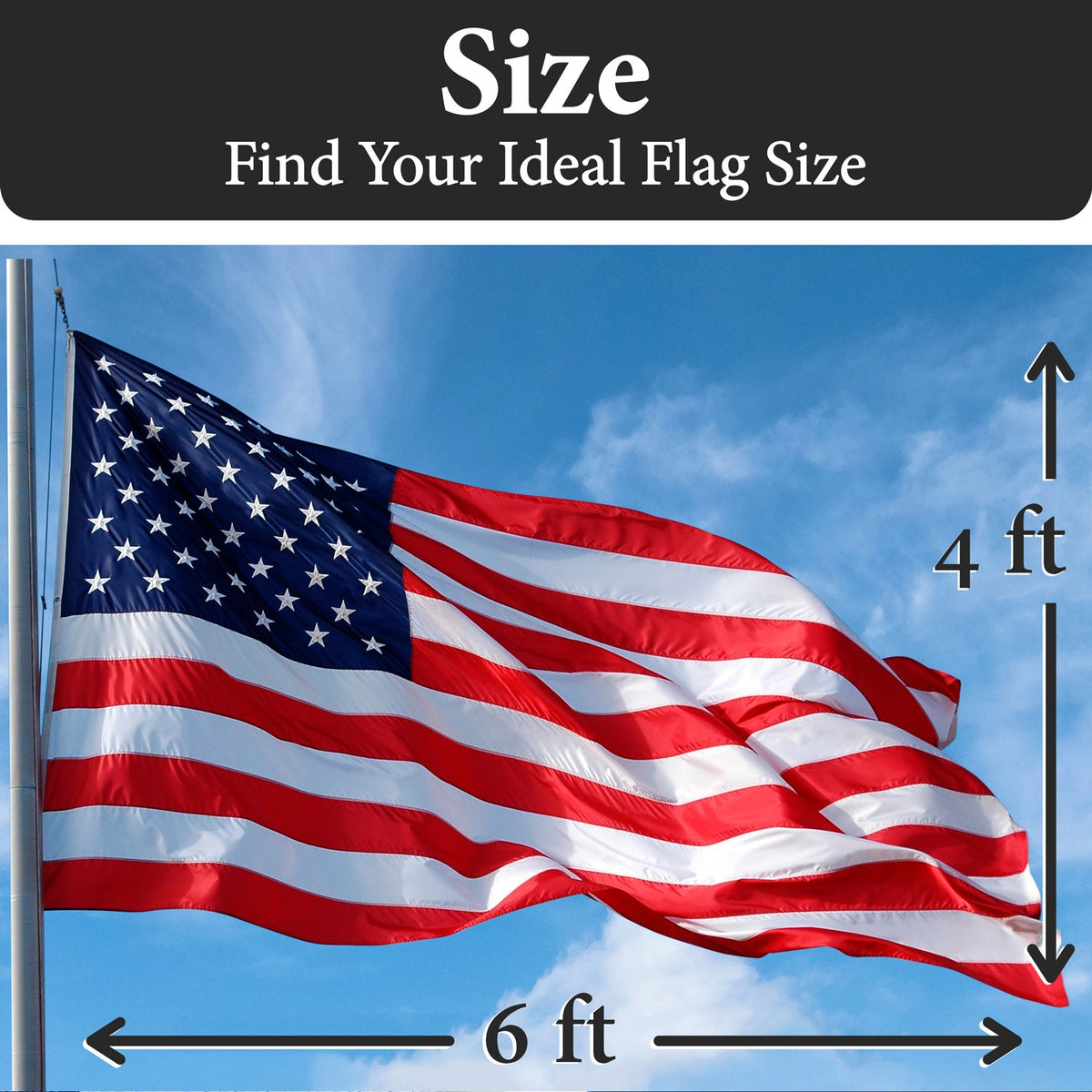
A bigger flag is a bigger sail. On a windy site we take the smaller size for that pole height and fly it in spun cloth. The full pole-to-flag chart lives in our size guide.
Size down before you size up.
Why the Fly End Fails First
The fly end is the free edge opposite the pole. That edge does the hardest work. Gusts crack it like a whip tip while the hoist side stays comparatively still. Fibers fatigue. Stitching loosens. Fray starts there and walks inward if you leave it alone.
We see the same pattern on flags that come back for a look. The field still looks bright. The stars still look clean. The fly hem is the chewed edge. Industry write-ups describe the same whip motion at that free edge (why flags fray at the fly end first). It is ordinary wear on a flag that has been flying, not a mystery defect.
Contact makes it worse. A rail or a roof edge will snag the fly end every time the wind shifts. So will a shrub that grew into the swing path. The Flag Code asks that the flag never touch anything beneath it (4 U.S.C. § 8(b)). Clearance and cloth both matter.
Clearance decides as much as cloth.
Construction That Slows That Wear
When we build a heavy duty american flag for exposed yards, we start with fabric weight, then lock down the edges that take the snap.
The fly hem is one of those edges.
We sew it as a built detail on the free end, then check that hem on the floor before a flag leaves us.
Our Everlast American Pride uses 2-ply spun polyester. Two layers of fiber go into a heavier cloth with a canvas-like hand. It needs more breeze to lift than light nylon. That is the point on a coastal lot or an open ridge. Less frantic whipping at the fly end. More cloth to absorb the load. Stars are embroidered on the canton. Stripes are sewn through the field. We stock it from 3x5 to 6x10 for residential poles that live in weather. We cut those sizes because that is the range where most windy house poles sit. Bigger sails belong on taller commercial poles, and we keep this line focused on the homes that write us about shredded hems.
Our Durable Patriot is embroidered high-grade nylon. It has a quadruple-stitched fly hem. Heavy-duty brass grommets sit in a reinforced polyester header. Both lines get embroidered stars and sewn stripes, so the color sits in the cloth itself. We put that build language here because a thin fly hem loses to wind before the fabric tires, and Durable is the line where we already publish those stitch and hardware details.
Header and grommets carry the hoist load. A thin header that pulls at the hardware fails no matter how good the field looks. We keep a solid header and metal grommets on both lines so the attachment side does not become the weak link while the fly end is taking the snap.
Nylon vs Spun Polyester for Wind
Nylon still earns its place on a sheltered porch. Embroidered nylon lifts in a light breeze and looks bright when a wall or a line of trees has already taken the edge off the wind. Put that same light cloth on a ridge with no windbreak and the fly end pays for it. Spun polyester is the heavier pick for open lots and coastal homes, where the air keeps moving and the flag never gets a rest. We wrote the full fabric tradeoff in our nylon vs spun polyester guide. This post is the wind-first version of that choice.
Coastal Homes and Salt Air
Coastal lots stack wind with sun off the water. Salt rides along on every breeze. Cloth that already struggles in inland gusts fails faster there. Spun polyester is the fabric we point coastal buyers toward for a flag for coastal homes. Nylon can still fly on a protected inland porch a few miles from the water. If the pole sits in the open with a clear fetch, we stay on Everlast.
Hardware needs a look too. Salt air is hard on anything that holds the flag up. We tell coastal customers to rinse salt off when they can and to watch grommets and snaps for corrosion. That step is care. It is not a product pitch.
Care Between Storms
An all-weather flag may stay up in foul weather when the display fits the Flag Code (4 U.S.C. § 6(c)). We still take a flag down when a named storm is coming. We also lower it when wet cloth is thrashing so hard the fly end is shredding itself. A soaked spun flag gets heavy. That extra load hits the same hem we are trying to protect.
Inspect after rough weather. Look at the fly end first. A few loose threads are normal. Fray that runs into the field means it is time to retire the flag with dignity (4 U.S.C. § 8(k)) and put a fresh one up. An opened hem says the same thing. We do not invent a month count for how long any outdoor flag lasts. How hard the site is and how many hours the flag flies decide that more than a slogan.
Keep the swing clear. If the cloth hits a rail or a branch every afternoon, no fabric wins that fight. Size down or move the mount before you blame the cloth.
Order the Flag That Matches Your Wind
Match the exposure first, then the size. For an open lot or a coastal home, start with Everlast American Pride 3x5. Step to 4x6 when the house sits far back and the chart still allows it. Use 5x8 or 6x10 only on taller poles that call for those sizes. See the whole spun line in our spun polyester flags collection. For a sheltered porch, stay with Durable Patriot embroidered nylon. Every flag we make is 100% made in the USA.
Related guides from our blog: Nylon vs spun polyester American flag. American flag sizes for house. Our American flags collection.
Questions About Flags for High Wind and Coastal Homes
Why does my flag tear at the edge?
The tear shows up at the fly end, the free edge opposite the pole. That edge whips hardest in gusts. Stitching fails there first. So do the outer fibers. Light cloth with a thin hem opens fast. Heavier 2-ply spun polyester and a fly hem built for that load slow that wear. Clear the flag of rails and shrubs so contact does not finish the job.
Should I buy nylon or spun polyester for high wind?
Spun polyester for high wind and coastal exposure. Nylon for sheltered porches and light-to-moderate yards where you want the flag to lift in a soft breeze. We make both: Durable Patriot in embroidered nylon, Everlast American Pride in 2-ply spun polyester. Pick by the site.
What is a 2-ply spun polyester flag?
Two layers of polyester fiber spun and woven into a heavier outdoor cloth. It feels closer to canvas than to light nylon. It needs more breeze to fly fully, and that weight helps on sites that shred thin flags. Our Everlast line is that construction. Stars are embroidered. Stripes are sewn. Sizes run 3x5 to 6x10.
Can I leave the flag up in storms?
The Flag Code allows an all-weather flag to display in foul weather when appropriate. We still lower ours ahead of severe storms. Wet spun cloth gets heavy, and that load hits the fly end and the hardware. After the weather passes, check the hem before you raise it again.
What size american flag for high wind on a house pole?
Start with the pole chart, then take the smaller size in that row on a windy lot. A typical residential answer is 3x5 on a 20 ft pole when the site is exposed. Upsize only when the house sits far back and the chart still allows it. Our size guide walks through bracket and in-ground picks.
When should I replace a frayed fly end?
Replace it when fray runs into the field. Replace it when the hem has opened. Replace it when the flag no longer looks like a fitting emblem. Minor loose threads can wait for your next inspection. A badly torn fly end is a signal to retire the flag with dignity and hang a fresh one sized and built for your wind.
Sources
- U.S. Flag Code, 4 U.S.C. § 6(c) (all-weather flag may be displayed in foul weather) (Cornell LII, accessed Oct 16, 2026): https://www.law.cornell.edu/uscode/text/4/6
- U.S. Flag Code, 4 U.S.C. § 8(b) (flag should never touch anything beneath it) and § 8(k) (worn flag destroyed in a dignified way) (Cornell LII, accessed Oct 16, 2026): https://www.law.cornell.edu/uscode/text/4/8
- EM Flag, Why Flags Fray at the Fly End First (fly end whip wear) (accessed Oct 16, 2026): https://emflag.com/blog/why-flags-fray-at-the-fly-end-first/
Share:
American Flag Sizes for House: What Fits Your Pole