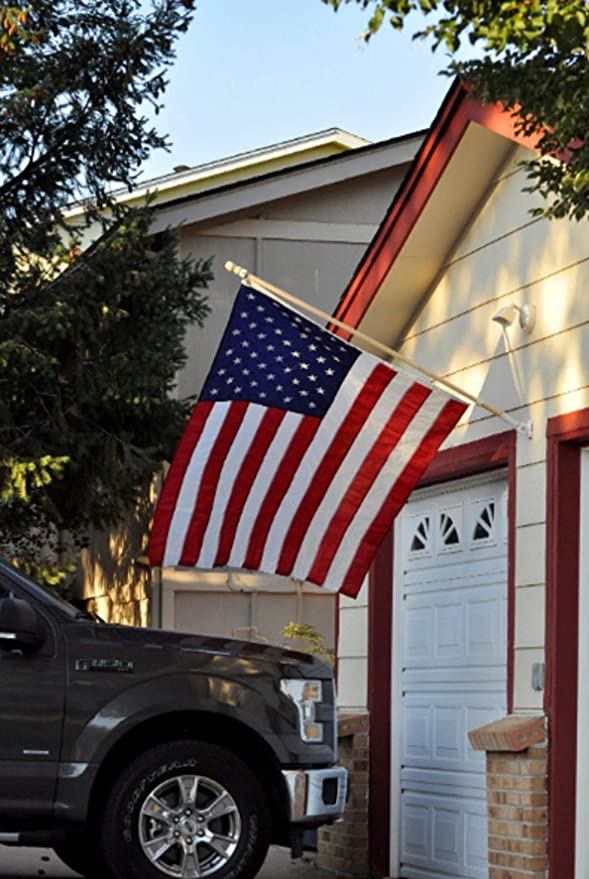
The first evening we left a test flag up past sunset, a 3x5 Durable Patriot on a porch bracket, we walked out to the sidewalk to look back at it. The porch light was on and the doorstep glowed. Above it hung a dark rectangle with no stripes we could pick out. That is where our guide to how to light a flag at night starts, with a flag we couldn't see from the street.
TL;DR: The Flag Code's custom is sunrise to sunset, and 24-hour display is allowed when the flag is "properly illuminated during the hours of darkness" (4 U.S.C. § 6(a)). The American Legion prefers a dedicated light aimed at the flag, or any light making it clearly visible and recognizable to a casual observer. Without a light, we lower ours at sunset.
How to Light a Flag at Night: What 4 USC 6(a) Says
We keep 4 U.S.C. § 6 open for this question, because the whole rule is two sentences: "It is the universal custom to display the flag only from sunrise to sunset on buildings and on stationary flagstaffs in the open. However, when a patriotic effect is desired, the flag may be displayed 24 hours a day if properly illuminated during the hours of darkness."
In that text, "may" tells us overnight display is allowed, never required. "Properly" is never defined, and the section names no brightness level or fixture type.
So the Code tells us when a light is needed and leaves the how to us.
What "Properly Illuminated" Means
The clearest definition we've found sits in the American Legion's flag FAQ: "a dedicated light aimed at the flag (preferred) or any light source strong enough for the flag to be clearly visible and recognizable to a casual observer." The same FAQ notes the Flag Code is a guideline with no penalties. We follow it anyway.
We turn that definition into a test. After full dark we stand on the sidewalk where a passerby would stand and ask two questions. Can we see the whole flag? Can we tell it's the American flag without already knowing it's there? Two yeses pass. It's the same walk from our Veterans Day flag etiquette guide.
We run the check again on a windy night, since a moving flag can swing right out of a beam.
Choosing a Light: Solar, Wired, Pole-Top or Porch
We make flags and don't sell a flag light, so this is no pitch, and we have no brightness numbers of our own.
| Light type | How it lights the flag | Where it fits | What we check |
|---|---|---|---|
| Solar spotlight | Staked or wall mounted and aimed up | Spots with no outlet and full sun | Rated run time against a winter night |
| Wired or low-voltage spotlight | Fixed beam powered from the house | In-ground poles and planned installs | Aim with the flag up and moving |
| Pole-top light | Clamps at the top and shines down | Poles with little ground space | Whether it fits the pole top |
| Porch or wall light | The fixture already by the door | Bracket flags right beside it | Whether the beam reaches the cloth |
A solar light charges by day and runs on stored power after dark, so December is its hard month, with short days to charge and the longest nights to cover. We'd hold the maker's rated run time up against a winter night where you live. Wired lights hold steady all night but need power at the spot, so we'd ask an electrician about permits and check HOA lighting rules first.
Setup by Mount: Bracket, In-Ground Pole and Wall
House bracket
On a porch bracket the flag hangs from a pole angled out from the house and swings through a wide arc, while the porch light usually sits below and behind it. We aim a spotlight up from the ground or the wall under the bracket, at the middle of the space where the flag hangs. Then we watch it in a breeze. If the fly end drifts out of the beam, we add a second light from the other side. Our guide to displaying the flag on a house covers which end of the pole the union goes on.
In-ground pole
On a freestanding pole the flag can end up on any side. Kichler's flagpole lighting guide, which is a lighting maker's own advice, places two fixtures 180 degrees apart or three at 120 degrees, 6 inches to 3 feet from the pole for low-voltage residential setups. We treat that as a starting layout and then check from the street.
Flat on a wall
A flag hung flat against a wall barely moves, so for us it's the easy case. One fixture aimed from above or below can cover it. While we're out on the sidewalk, we also confirm the union sits at the top and on the observer's left, as the Legion FAQ describes.
How Light Plays on Nylon and Spun Polyester
The lighting guides we read don't compare fabrics under a beam, and it's what we notice most on our test flags. Our Durable Patriot is high-grade nylon, and its listing describes "deep blues and vibrant reds that shed water naturally." Under a spotlight aimed close, that smooth cloth throws a bright streak along each fold. The embroidered stars stand slightly proud of the blue. A beam from below gives each one a small shadow, so they read crisp from the sidewalk. Our Everlast American Pride is 2-ply spun polyester, and its listing calls the look "canvas-like." That matte cloth takes the light evenly, with no streak. The trade-off is depth. Its reds and blues look darker at night, so on an Everlast we bring the fixture closer, and on a Durable we tilt the beam off the folds until the glare settles. Neither listing gives a reflectance figure and we haven't measured one, so read this as what we see from the curb.
The Durable's listing calls out heavy-duty brass grommets and a reinforced polyester header, and a pole-top light shining down hits that header edge first. The Everlast listing doesn't describe its header or grommets, so we won't either.
Our Flags for Overnight Display
For a sheltered bracket by the door, we point people to the 3x5 Durable Patriot. For an open yard with steady wind, our high wind guide explains why we pick the Everlast, whose listing says it is "specially designed for extreme weather." Both live in our American flags collection, and our nylon vs spun polyester guide compares them by daylight. Whichever you fly, we settle how to light a flag at night the same way, from the sidewalk.
Flag Lighting Questions
Do you have to light an American flag at night?
Only if it stays up after dark. Under 4 U.S.C. § 6(a) the custom is sunrise to sunset, and 24-hour display is allowed when the flag is properly illuminated during the hours of darkness. When we can't light a flag, we lower it at sunset and raise it in the morning.
Does a porch light count as proper illumination?
It can. The American Legion accepts any light strong enough for the flag to be clearly visible and recognizable to a casual observer, though it prefers a dedicated light aimed at the flag. If the porch light only reaches the siding, we add an aimed light.
Is a solar flag light bright enough?
Sometimes. The Flag Code names no brightness, so we use the Legion's test: is the flag clearly visible from the street? Winter brings short days to charge and long nights to cover, so we check the maker's rated run time and look at the flag late in the evening.
Where should I aim a light on a house-mounted flag?
At the middle of the space where the flag hangs, aimed up from the ground or the wall below the bracket. A bracket flag swings out from the house, so we watch it in a breeze. If one light leaves the fly end in shadow, a second light from the other side helps.
How many lights does a flagpole need?
The Flag Code doesn't say. Kichler's flagpole lighting guide uses two fixtures 180 degrees apart or three at 120 degrees around a residential pole. On our own setups we walk around the pole after dark and look for any side where the flag goes dark.
Sources
- U.S. Flag Code, 4 U.S.C. § 6 (time and occasions for display): § 6(a) sunrise to sunset, 24 hours if properly illuminated during the hours of darkness (Cornell LII, accessed Nov 13, 2026): https://www.law.cornell.edu/uscode/text/4/6 · https://uscode.house.gov/us/usc/119-138/t4/s6/
- The American Legion, U.S. Flag Myths, FAQs and Terminology: definition of proper illumination; Flag Code has no penalties; wall display orientation (accessed Nov 13, 2026): https://www.legion.org/advocacy/flag-advocacy/frequently-asked-questions
- Kichler Lighting, Flagpole Lighting With LED Lights (manufacturer guidance, not an official rule): fixture spacing and distance for residential poles (accessed Nov 13, 2026): https://www.kichler.com/tips-guides/landscape-lighting-guide/lighting-a-flagpole
- Rushmore Rose USA, Durable Patriot and Everlast American Pride product pages (materials, construction and sizes as listed) (accessed Nov 13, 2026): https://rushmoreroseusa.com/products/durable-patriot-premium-embroidered-american-flag · https://rushmoreroseusa.com/products/everlast-american-pride-spun-polyester-outdoor-flag
Share:
Outdoor TV Cover Size Guide: How to Measure Your TV (40" to 90") and Winterize It