Every so often we get a call from someone standing in a driveway with a new pole across two sawhorses, asking which end is the top. It is a fair question. There is a little pulley assembly in one bag, a gold ball in another, and a coil of rope with nothing that says where it goes. Most people never think about what a flagpole is until they own one. When they search for flagpole meaning, they usually want the names of the pieces first. Then the rules for raising a flag. And sooner or later, why a flag halfway down a pole means somebody died.
TL;DR: A flagpole is a vertical staff built to raise and display a flag. On a standard in-ground pole, a rope called the halyard runs up over a pulley in the truck at the top and back down to a cleat near the ground, where it ties off. We get asked about this more than the definition itself. Federal law defines half-staff as the point halfway between the top and the bottom of the staff. As a symbol, the pole marks a place and says who it belongs to.
Flagpole Meaning: The Definition
A flagpole, also written flag pole or flagstaff, is a tall pole designed to raise a flag and hold it up where it can fly free and be seen.
The Flag Code itself barely uses the word. It prefers "staff," and talks about "stationary flagstaffs in the open" and a staff "projecting horizontally or at an angle from the window sill, balcony, or front of a building" (>4 U.S.C. § 6; >4 U.S.C. § 7). Sailors say mast, though on a lot of ships the national flag flies from a gaff or a staff at the stern. We call anything set in the ground a flagpole and the short ones that go in a bracket by the front door house poles.
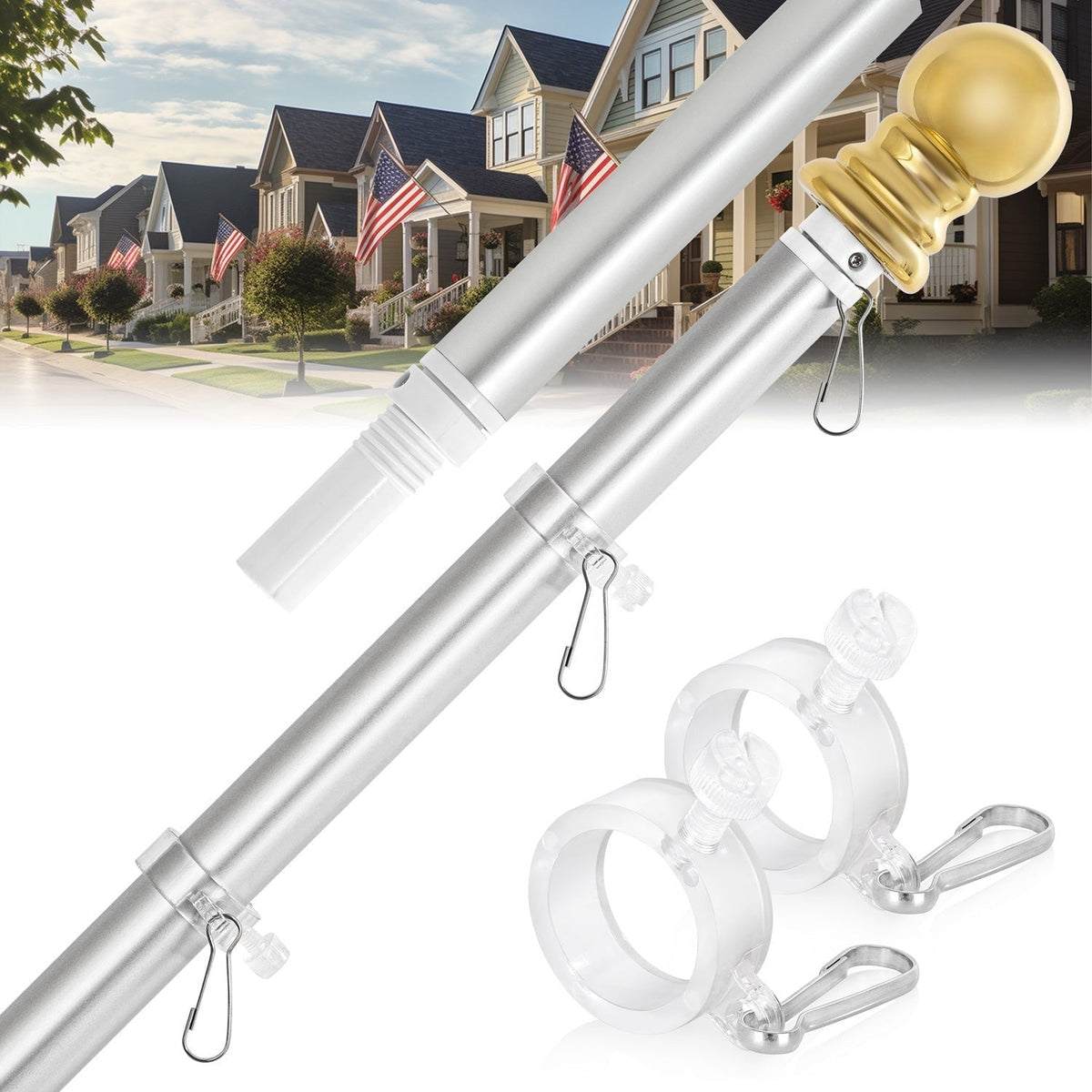
Here is what we tell those callers, top to bottom. The gold ball is the finial, and it is pure decoration; some people swap it for an eagle. Right under it sits the truck, the cap that holds the pulley, and that part does the actual work. The halyard is the rope. It goes up over the truck's pulley and comes back down, and two snap hooks on it clip into the grommets on the flag's header. Near the bottom of the shaft there is a cleat, a little metal horn you wrap the halyard around in a figure eight so the flag stays put overnight. At ground level a flash collar, a trim ring, hides the rough gap where the pole meets the concrete. One practical tip we give everyone: look at the halyard every spring, and once it turns fuzzy or stiff, replace it before it lets go with the flag at the top.
Some poles hide the rope inside the shaft, which we like for yards along a busy sidewalk, because nobody walking by can lower your flag for a joke. Telescoping poles skip the rope entirely. You clip the flag on and push the sections up.
What It Means When the Flag Is at Half-Staff
We get asked about this more than the definition itself. Federal law defines half-staff as "the position of the flag when it is one-half the distance between the top and bottom of the staff" (>4 U.S.C. § 7(m)). The procedure is spelled out too. Hoist the flag to the peak for an instant, lower it to half-staff, and raise it to the peak again before taking it down for the day. Memorial Day runs half-staff until noon only, then full staff. Most of the modern rules for who orders half-staff and for how long trace back to Proclamation 3044, which President Eisenhower signed on March 1, 1954.
Half-staff or half-mast? On land, half-staff. Half-mast is the naval term, and I have never once corrected anyone at a cookout over it.
Bracket poles are the headache. They have no halyard, so there is no halfway point to lower the flag to, and every time a proclamation goes out our inbox fills with people who just realized it. What most folks do is tie a black mourning streamer at the top of the staff. The Flag Code does not mention streamers. We treat it as a respectful custom and leave it at that.
On a day of mourning I would rather see a streamer than a bare bracket.
What a Flagpole Symbolizes
I think the pole is the quiet partner in every flag display. The flag gets the attention, but the pole decides where the flag stands and how high, and putting one in the ground says this place belongs to someone or stands for something. On February 23, 1945, Marines on Iwo Jima tied a flag to a length of Japanese water pipe they found on the summit of Mount Suribachi, and later a second, larger flag went up on another pipe (>Marine Corps History Division). Joe Rosenthal of the Associated Press photographed the second raising, and the picture won him the Pulitzer Prize later that year.
The pole in it was scrap.
The Code puts manners into the motion as well: the flag should be "hoisted briskly and lowered ceremoniously" (>4 U.S.C. § 6(b)). New owners tend to do the opposite. They ease it up slowly, then let it slide down fast. When we explain halyards to a first-time owner, that is the line we quote, and we think it does more good than anything else we could say about rope.
The pole has crept into the language, too, and I am fond of both phrases it gave us. "Run it up the flagpole and see who salutes" was Madison Avenue slang by the 1950s, and a version of it comes out of the ad-man juror's mouth in the 1957 film 12 Angry Men. It still means float an idea and watch the reaction. Flagpole sitting was a real 1920s fad, and Alvin "Shipwreck" Kelly made a career of perching on top of poles for days.
Putting a Flag on Your Pole
Get the size right before anything else. Our American flag size guide for houses matches flag size to pole height, from a 2x3 on a short bracket to a 12x18 on a 60 ft pole. Every flag we sell is made in the USA. The Durable Patriot is 100% nylon with embroidered stars and sewn stripes, and it lifts in light air. The Everlast American Pride is 100% spun polyester, the one we hang on windy, exposed poles. Both are in our American flags collection. And if you're planning to lower yours on November 11, hold off. Our Veterans Day flag etiquette guide explains why that one is a full-staff day.
Flagpole Meaning: Common Questions
What is the meaning of a flagpole?
A flagpole is a vertical staff built to raise and display a flag so it can fly free and be seen. Symbolically, it marks a place as belonging to a nation or a household. That is the flagpole meaning most people sense without putting it into words. When the flag sits halfway down the pole, at half-staff, it signals mourning.
What are the parts of a flagpole called?
From the top: the finial, the truck with its pulley, the halyard rope with snap hooks for the flag, the shaft, and the cleat where the rope ties off. A flash collar covers the base. Internal-halyard poles run the rope inside the shaft, and many house poles have no rope at all.
Is half-staff the same as half-mast?
Yes, in meaning. Half-staff is the term for flags on land, and it is the term federal law uses. Half-mast is the naval term for flags flown on ships. Both describe the same position: the flag lowered to the midpoint of the staff as a sign of mourning or respect.
Why is the flag raised briskly and lowered slowly?
The Flag Code says the flag should be "hoisted briskly and lowered ceremoniously." Raising it quickly shows energy and pride. Lowering it slowly shows respect, and it gives you time to gather the flag before any part of it touches the ground, which the Code also asks you to avoid.
Can you fly a flag at half-staff on a house bracket?
Not in the usual sense, because a bracket pole has no halyard to lower the flag partway. A common practice is to attach a black mourning ribbon or streamer at the top of the staff above the flag. The Flag Code itself does not mention streamers.
What is on top of a flagpole?
The top of a flagpole holds the truck, which contains the pulley for the halyard, and above it the finial, an ornament such as a ball or an eagle. Texas law even suggests a star or spearhead finial for its state flag. The finial is decorative, while the truck does the work.
Keep reading: From 13 Stripes to 50 Stars: The History of the American Flag and American Flag Quotes: 15 Lines Checked Against the Source.
Share:
American Flag Quotes: 15 Lines Checked Against the Source
Front Yard Flag Pole Landscaping: 9 Ideas That Keep the Flag in Charge