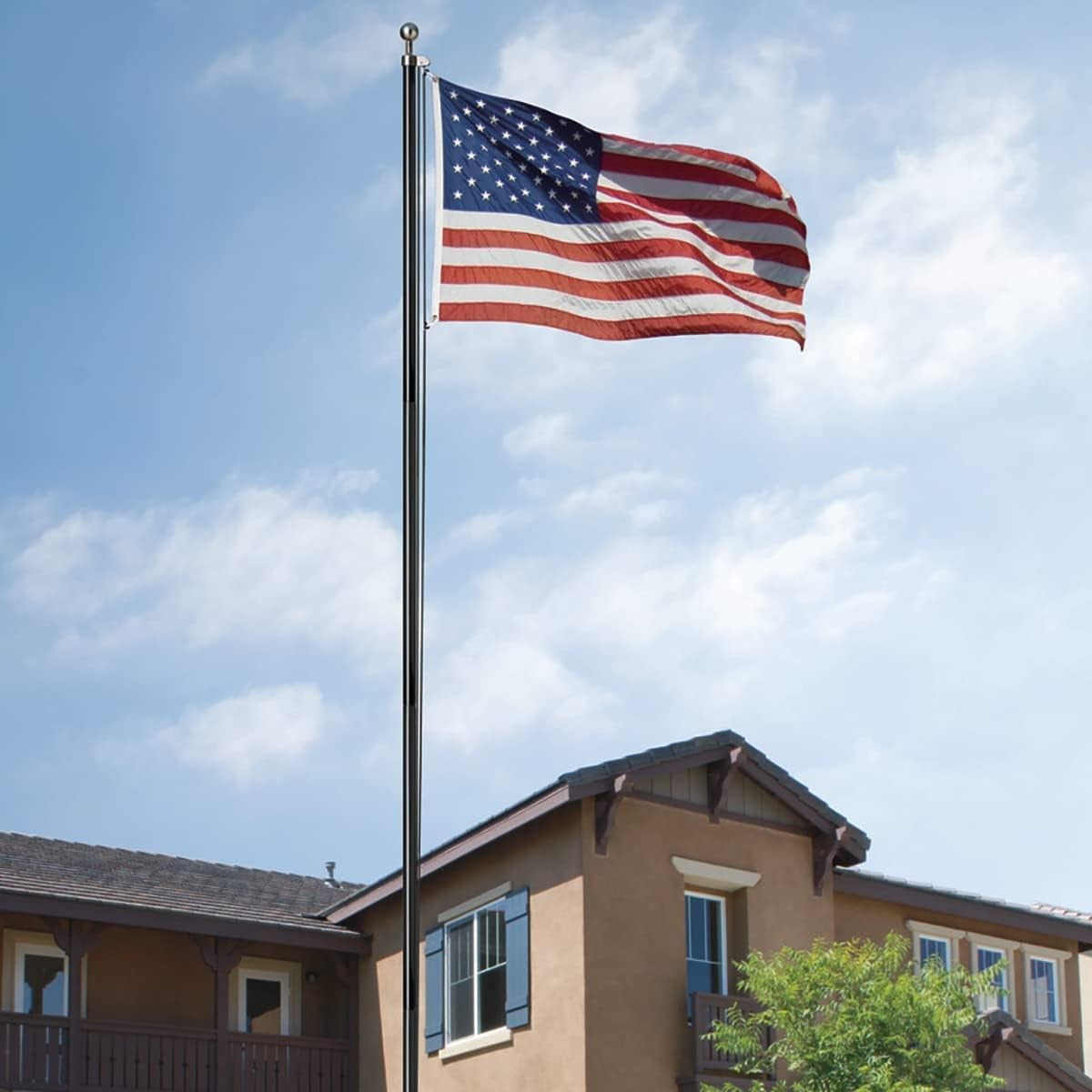
The photo that started this rewrite showed a new in-ground pole in the middle of a bare lawn, a fresh 3x5 on top and a ring of torn-up sod at the base. Under it was one line: what do I plant here? I get some version of that note every spring. My answer always runs longer than people expect, because good flag pole landscaping has to frame the pole and stay out of the flag's way at the same time, and those two goals fight each other more than you would think.
TL;DR: Measure how low the flag hangs on a dead-calm day and keep every plant under that line. Leave a path to the halyard. Put the tall plants at the outside edge of the bed. Call 811 before the shovel goes in. If the flag stays up at night, light it.
Before You Plant: Three Checks We Run First
Every flag pole landscaping plan we draw starts at the pole, and the garden center can wait.
The swing comes first. With no wind the flag hangs limp along the pole, and in a gust it can wrap around and dip lower than you'd guess from watching it on a nice afternoon. The Flag Code says the flag should never touch anything beneath it (>4 U.S.C. § 8(b)). Anything that brushes a flying flag also chews up the fly end over a season. So we run a tape measure from the ground to the bottom hem while the flag hangs at full staff, and we write that number down. Every plant in the bed stays well under it. A shrub that sits a foot below the hem today and creeps toward it for three summers will win that fight, and the flag loses.
Then access. Somebody has to reach the cleat every time the flag goes up or comes down, and again when a proclamation sends it to half-staff. I have seen handsome beds where the owner had to step on the hostas to reach the rope. Leave a stepping stone or two, or just a gap, on the side where the halyard ties off.
Last, what is underground. Call 811, the national call-before-you-dig line, a few days ahead so the utility companies can paint their lines on your lawn.
9 Flag Pole Landscaping Ideas for the Front Yard
1. A circle bed with the pole dead center. Most lots can take this one, and it is where I would start if you are unsure. Cut a round bed and edge it in brick or steel. The edge matters more than whatever you plant inside it. A crisp line makes a flat of ordinary annuals look planned.
2. A star cut into the lawn. On a corner lot or a big open front yard, a five-point star reads from the street. We fill it with one low ground cover. Mix three plants in there and the points go fuzzy by July.
3. Tall plants on the outside. If a bed looks wrong and you can't say why, this is usually the reason. Ornamental grasses or a short row of boxwood belong on the outer ring, where they frame the pole from the sidewalk without getting anywhere near the flag. Inside that ring, go low.
4. Short plants at the base. Right at the pole we use creeping thyme or liriope in part shade and low sedum in full sun. They spread and stay short, and they don't mind a boot on them when you go for the halyard.
5. A red, white and blue bed. People ask about this one in the week before Memorial Day. For the red I'd use salvia or geraniums. Sweet alyssum covers the white. Blue is lobelia or petunias. I like them planted in rings with blue closest to the pole, so the bed mirrors the blue canton above it. Planted in clumps, the same flowers look like a seed packet tipped over.
6. Rock and a couple of boulders. For a dry yard where watering is a losing battle, we like river rock with two or three boulders, because it looks the same in January as in June. Bury each boulder a third of the way down. Set on top of the gravel, they look like they fell off a truck.
7. A low post-and-chain border. It gives the pole a memorial feel and keeps the mower from nicking the base. We tend to suggest it to families who fly a POW/MIA or service flag under the Stars and Stripes.
8. Mulch and an edge. That's it.
A tight ring of dark mulch with a clean spade-cut edge is the easiest of these to keep up, and nothing in it competes with the flag.
9. An uplight. The Flag Code allows display 24 hours a day "if properly illuminated during the hours of darkness" (>4 U.S.C. § 6(a)). One fixture set in the bed and aimed up the pole covers it. Put it on the house side, away from the street, or you'll be shining it into the eyes of every driver who comes around the corner.
Front Yard Flag Pole Ideas by Climate
Customers write to us from every region, and the same circle bed needs different plants in each one. In the Southwest I'd lean on rock and agave, with lantana for color on a drip line. Southeast yards get through the heat and humidity better with dwarf yaupon holly and liriope. Up north, boxwood and daylilies. Add a mulch ring there too, since mulch doesn't care how much snow lands on it. The coast is its own problem. Salt spray burns soft leaves, and the wind off the water rarely quits, so plants there need to be tough and short. The flag matters even more in that spot. A flag on an exposed coastal pole frays at a rate that surprises anyone who has only flown one in a sheltered backyard, and the fabric decides how long it keeps its color and a clean fly end.
Pick the Flag Before You Finish the Bed
I mean that literally. The flag sets the height limit for everything you plant, because a bigger flag hangs lower on the pole. Trade a 3x5 for a 4x6 and the bottom hem drops a full foot. Our American flag size guide for houses matches flag size to pole height, from 2x3 to 12x18.
For fabric, our nylon vs spun polyester guide lays out the trade-off. Our short version: the Durable Patriot is 100% nylon with embroidered stars and sewn stripes, and it lifts in light air. The Everlast American Pride is 100% spun polyester, and it is the one we would hang on an open, windy lot. Both are made in the USA. The rest of the lineup is in our American flags collection.
Then plant.
Front Yard Flag Pole Landscaping Questions
What should I plant around a flag pole?
Plant low, tidy plants at the base and save taller ones for the outer edge of the bed. Creeping thyme and liriope work near the pole. Boxwood or ornamental grasses work at the edge. Keep everything below the lowest point the flag reaches when it hangs limp.
How big should a flag pole bed be?
Big enough to look intentional from the street and to give you a clear path to the halyard. For most front lawns we usually suggest a round bed between 6 and 10 feet across. A taller pole looks better with a wider bed, so scale it up as the pole height goes up.
Should I use mulch or rock around a flag pole?
Both work. Mulch suits yards with plants and regular rain. Rock suits dry climates and owners who want low maintenance. Whichever you choose, finish it with a hard edge so grass does not creep in. Keep rock away from the halyard path so it does not turn underfoot.
Do I need a light on my flag pole?
Only if you leave the flag up after dark. The Flag Code says the custom is sunrise to sunset, and that the flag may fly 24 hours a day when it is properly illuminated. An uplight in the landscape bed, aimed at the flag, is the common setup for homes.
What flowers are red, white and blue for a flag pole bed?
For red, try salvia or geraniums. For white, sweet alyssum or white petunias. For blue, lobelia or ageratum. Plant them in bands around the pole, with blue in the ring closest to it. Check that each one suits your sun exposure and growing zone before you buy.
Can trees grow near a flag pole?
Keep trees far enough away that no branch can reach the flag in a strong wind, and remember trees grow. A flag that catches on a branch tears at the fly end fast. If a tree is already close, trim it back.
Keep reading: Flagpole Meaning: What a Flagpole Is, How It Works, and Why It Matters.
Share:
Flagpole Meaning: What a Flagpole Is, How It Works, and Why It Matters
American Flag Clothing: Do's and Don'ts From the Flag Code