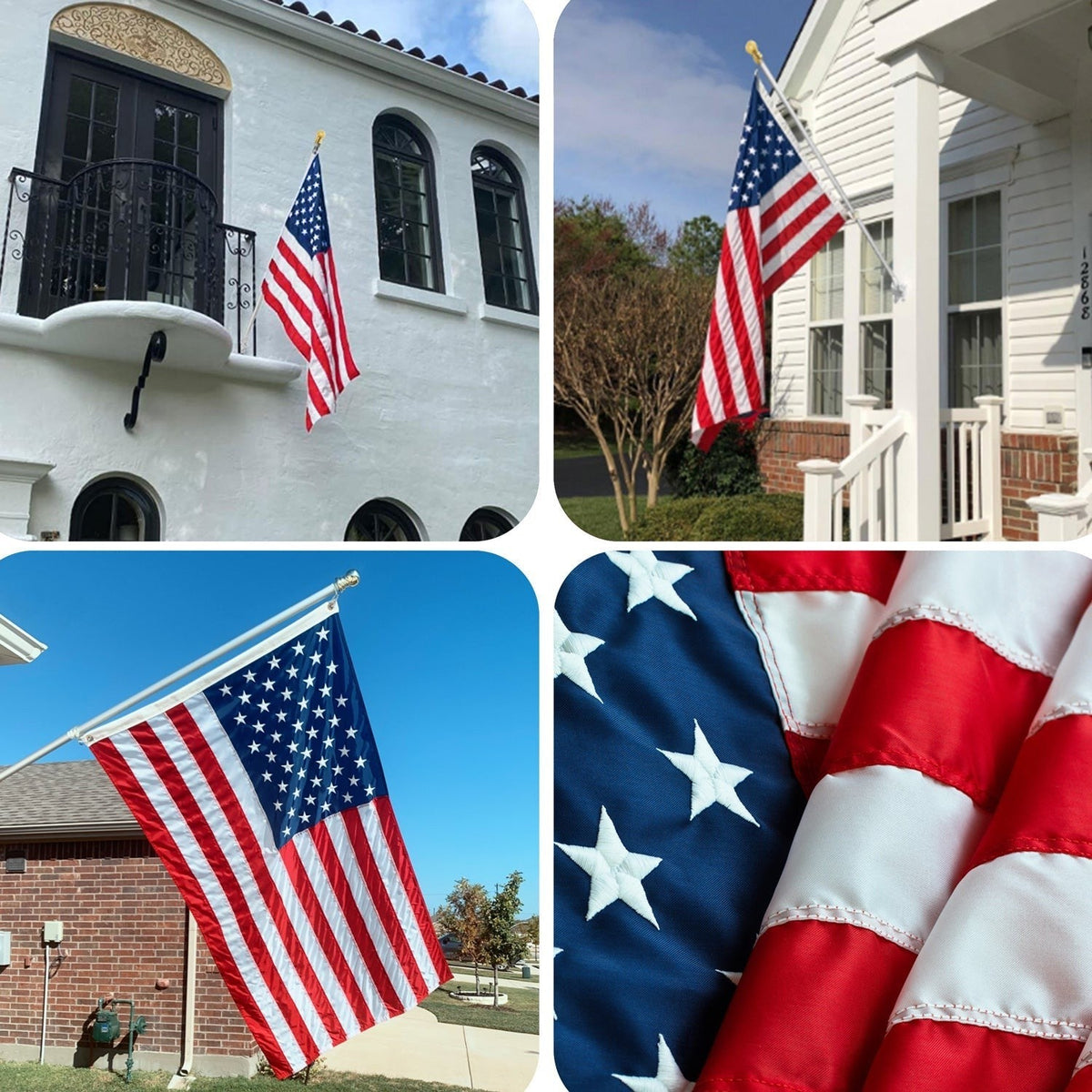
Count the stripes on the flag by your front door. Thirteen: seven red and six white, red on the top and the bottom. We get asked that question more than any other history question, usually by a parent helping with homework. The answer is simple. The story of how we got there is not, and the history of the American flag includes a year when the flag had fifteen stripes, 135 years with no official star layout, and a federal statute that still says "forty-eight stars." Here is the short version, checked against the laws and the Smithsonian.
TL;DR: Congress set the first flag on June 14, 1777: thirteen red and white stripes and thirteen white stars on blue. A 1794 law moved it to fifteen stars and fifteen stripes. The Flag Act of 1818 went back to thirteen stripes for good and added one star per state, each new star on the Fourth of July after a state joins. The 50-star flag became official on July 4, 1960, and it has now flown longer than any earlier version.
How Many Stripes Are on the American Flag, and Why 13?
Thirteen, for the thirteen original colonies. We point people to the law itself here. The stripes alternate red and white, which puts seven red stripes and six white ones on every flag. Federal law still describes it this way: "thirteen horizontal stripes, alternate red and white" (>4 U.S.C. § 1).
There was one exception.
We get to it below.
The 1777 Resolution That Started the History of the American Flag
On June 14, 1777, the Continental Congress resolved "That the flag of the thirteen United States be thirteen stripes, alternate red and white; that the union be thirteen stars, white in a blue field, representing a new constellation." That date is why Flag Day falls on June 14. The resolution set colors and counts. It said nothing about how to arrange the stars, so flag makers arranged them in circles and rows for decades. We have seen photos of early flags with stars in shapes that would look odd on a porch today.
Who designed it? We wish we could give a clean answer. Francis Hopkinson, a signer of the Declaration of Independence, asked Congress to pay him for designing the flag. Congress did not pay. The Betsy Ross story first reached the public in 1870, when her grandson William Canby presented it to the Historical Society of Pennsylvania (>Canby's paper, ushistory.org). It is a family account, and no document from 1776 or 1777 confirms it. We tell customers both stories and let them weigh the evidence.
Fifteen Stars and Fifteen Stripes
We think this is the strangest chapter. When Vermont and Kentucky joined the Union, Congress responded with the second Flag Act, approved January 13, 1794. It added a star and a stripe for each new state, making fifteen of each. This is the flag that flew over Fort McHenry in September 1814. Mary Pickersgill of Baltimore sewed that garrison flag in 1813 at 30 by 42 feet, with each stripe two feet wide, and the sight of it at dawn on September 14 moved Francis Scott Key to write the poem that became the national anthem (>Smithsonian, Facts about the Star-Spangled Banner). The flag is at the National Museum of American History today, now 30 by 34 feet after years of pieces being cut off as souvenirs.
The Flag Act of 1818: Back to 13 Stripes
Adding a stripe for every state was never going to work, and we suspect Congress knew it. By 1818 there were twenty states. The third Flag Act, passed April 4, 1818, fixed the stripes at thirteen to honor the original colonies and gave each state a star. New stars would be added on the Fourth of July after a state's admission. That rule is still law: "On the admission of a new State into the Union one star shall be added to the union of the flag; and such addition shall take effect on the fourth day of July then next succeeding such admission" (>4 U.S.C. § 2).
From 48 Stars to 50
Here is a detail we love. For 135 years, from 1777 to 1912, the law set the number of stars but not their layout. That ended when President Taft issued an executive order that fixed the flag's proportions and set the 48 stars in six rows of eight. Then came the statute we mentioned up top. Title 4, section 1 of the US Code still reads "the union of the flag shall be forty-eight stars," a 1947 text that nobody has rewritten. Section 2 does the adding. Alaska's star arrived on July 4, 1959. Hawaii was admitted on August 21, 1959, and the same day President Eisenhower signed Executive Order 10834, which fixed the 50-star design (>National Archives, Executive Order 10834). It took effect on July 4, 1960. It is the 27th official version of the flag, counting from 1777. And the 48-star flag, which flew from 1912 to 1959, held the record for longest service until the 50-star flag passed it.
What about the high school student?
You may have heard that Robert Heft designed the 50-star flag for a class project in Lancaster, Ohio, and got a B-minus. Heft did make a 50-star flag for school. But a 2022 investigation by Slate found that his larger claims, including that his design was the one officially chosen, do not hold up (>Slate, 2022). We still tell it, caveat attached.
It is still a good classroom story.
How the 50-Star Flag Is Laid Out
We describe the current flag to customers this way: 50 white stars in nine rows that alternate six and five stars, staggered so they also form eleven columns. The stripes are the same thirteen. The executive order sets the proportions, with a fly 1.9 times the hoist for official government flags. A 3x5 house flag works out to 1.67, so ours will never hit 1.9, and every so often a customer measures one and asks us why. That's normal. The government's own size list includes 3x5 and 5x9.5 flags.
Our flags follow the same 50-star, 13-stripe pattern, and every flag we sell is made in the USA. The Durable Patriot is 100% nylon with embroidered stars and sewn stripes. If your pole takes a beating from the wind, look at the Everlast American Pride, which is 100% spun polyester. Our printed polycotton 3x5 is 70% polyester and 30% cotton, a good pick for a classroom. Compare them in our American flags collection, and if you are choosing fabric, start with our nylon vs spun polyester guide.
History of the American Flag: Quick Questions
How many stars and stripes are on the American flag?
The current flag has 50 stars, one for each state, and 13 stripes for the original colonies. The stripes alternate red and white, so there are seven red and six white, with red at the top and bottom. The 50-star design has been official since July 4, 1960.
Why are there 13 stripes and not 50?
Congress tried adding stripes. The 1794 Flag Act gave the flag fifteen stripes for fifteen states. As more states joined, that became unworkable, and the Flag Act of 1818 fixed the stripes at thirteen for the original colonies while adding one star per state. That rule has held ever since.
How many versions of the American flag have there been?
In the history of the American flag, the 50-star flag is commonly counted as the 27th official version since 1777. Each change came from adding stars for new states, plus the 1794 change to fifteen stripes. The 50-star flag has flown since 1960, longer than any earlier version, including the 48-star flag of 1912 to 1959.
Did Betsy Ross make the first American flag?
No document from the 1770s confirms it. The story became public in 1870, when her grandson William Canby told it to the Historical Society of Pennsylvania. Francis Hopkinson, a signer of the Declaration of Independence, claimed credit for the design and asked Congress for payment, which he did not receive.
When is a new star added to the flag?
On the Fourth of July after a state is admitted, under 4 U.S.C. § 2. Alaska became a state in January 1959 and its star appeared on July 4, 1959. Hawaii joined in August 1959, and the 50-star flag became official on July 4, 1960.
Who designed the 50-star flag?
Executive Order 10834, signed by President Eisenhower on August 21, 1959, set the design. Robert Heft of Lancaster, Ohio, made a 50-star flag as a high school project and later said his was the design chosen. A 2022 Slate investigation found those claims are not supported by the record.
Keep reading: American Flag Quotes: 15 Lines Checked Against the Source and Flagpole Meaning: What a Flagpole Is, How It Works, and Why It Matters.
Share:
American Flag Quotes: 15 Lines Checked Against the Source