Search for "red flag with blue circle and 3 white stars" and Google sends you to Tennessee. We know because that exact phrase brought readers to our old post on the Tennessee state flag. It is a good description, as far as it goes. What it misses is the reason behind each piece, and the fact that Tennessee law tells you which way the stars have to point. We rebuilt this post from the state's own sources so you can answer both questions.
TL;DR: The Tennessee state flag is a red field with a blue circle edged in white, holding three white stars, plus a narrow blue bar at the fly end. The stars stand for East, Middle and West Tennessee, the state's three grand divisions. Capt. LeRoy Reeves of Johnson City designed it, and the General Assembly adopted it on April 17, 1905.
Tennessee Flag Meaning, in the Designer's Words
We rarely get to quote the person who drew a state flag. With Tennessee we can. The Secretary of State publishes Capt. Reeves's own explanation (>Tennessee Secretary of State, State Symbols):
"The three stars are of pure white, representing the three grand divisions of the state. They are bound together by the endless circle of the blue field, the symbol being three bound together in one, an indissoluble trinity. The large field is crimson. The final blue bar relieves the sameness of the crimson field and prevents the flag from showing too much crimson when hanging limp. The white edgings contrast more strongly the other colors."
(The state's published text uses a dash before "an indissoluble trinity." We set it as a comma.)
That last line about hanging limp is the part we like best. Reeves was thinking like a flag maker. A flag spends a lot of its life drooping on a calm day, and he designed for that.
Tennessee State Flag History
Tennessee tried before. A 1905 legislative resolution honoring the flag's centennial notes a failed attempt to adopt a flag in 1861, and a design approved by joint resolution in 1897 for the Centennial Exposition (>Tennessee General Assembly, HJR 8). Reeves, then a captain in Company F of the Third Infantry in the Tennessee National Guard, submitted his own design. The General Assembly adopted it as Chapter 498 of the Public Acts of 1905, on April 17 of that year. The Tennessee State Museum quotes a letter in which Reeves admitted he had given up hope the bill would pass. The day after it did, he wrote to a friend about the telegram that said "Congratulations. Flag bill has passed" (>Tennessee State Museum). Reeves raised the first official flag over the Armory in Johnson City in August 1905. He left that flag to the state in his will, and it is in the Tennessee State Museum's collection today.
We find something steady in that story. One officer drew it and one law adopted it. The state's legislative manual notes the flag statute has been altered only once since 1905.
That is rare.
How the Stars Must Sit on the Tennessee Flag
This is the part most people never notice, and it is where homemade and imported Tennessee flags go wrong. The statute, now Tennessee Code § 4-1-301, describes the layout in detail (>Tennessee Legislative Manual, state symbols). The flag is one and two thirds times as long as it is wide. That is a 3:5 ratio, exactly the shape of a 3x5 flag. The blue circle, not counting its white edge, is half the width of the flag. Inside it, three five-pointed stars sit at equal intervals around the center. One point of each star reaches toward the other two at the middle without touching them. Two outer points of each star reach toward the edge of the circle, again without touching it. Then comes the rule that settles which way is up. No two stars can line up parallel to the top or the side of the flag. And the highest star must be the one closest to the upper corner by the pole.
If the top star points away from the pole, the flag is upside down.
Flying the Tennessee Flag With the US Flag
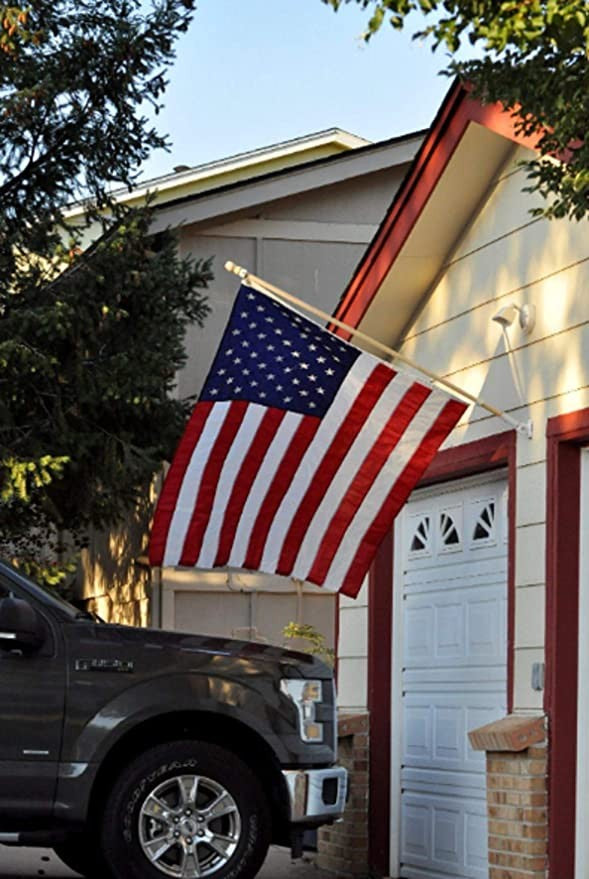
The federal Flag Code sets the same rules for every state flag (>4 U.S.C. § 7). On one halyard, the US flag goes at the peak. On two poles, the US flag goes on its own right, your left as you face them, and it goes up first and comes down last. No state flag goes above it. We pair flags of the same size, and since Tennessee's flag is a 3:5 rectangle, a 3x5 Tennessee flag next to a 3x5 Durable Patriot is a clean match. The Durable Patriot is 100% nylon with embroidered stars and sewn stripes, made in the USA.
For a hilltop in East Tennessee or an open lot that catches the wind, we would look at the Everlast American Pride instead. It is 100% spun polyester and also made in the USA. Our nylon vs spun polyester guide explains how we choose between them, and our American flags collection has every size.
Tennessee joined the Union on June 1, 1796, as the 16th state. The Flag Code lists state admission days among the days to fly the flag (>4 U.S.C. § 6(d)).
How the Tennessee Flag Ranks
In the North American Vexillological Association's 2001 survey of 72 flags from US states, Canadian provinces and US territories, Tennessee placed 14th with 6.98 out of 10 (>NAVA survey results, archived). That puts it well ahead of the seal-on-a-bedsheet designs that fill the bottom of the list. Flag designers reward simple shapes that read from a distance, and three stars in a circle are easy to spot on a pole a block away.
We would have ranked it higher.
Tennessee State Flag Questions
What do the three stars on the Tennessee flag mean?
They stand for the three grand divisions of Tennessee: East, Middle and West. The designer, Capt. LeRoy Reeves, wrote that the blue circle binds them together "in one, an indissoluble trinity." Tennessee law places the stars so that no two line up with the top or side of the flag.
What state has a red flag with a blue circle and 3 white stars?
Tennessee. Its flag is a crimson field with a white-edged blue circle holding three white stars, plus a narrow blue bar at the fly end separated by a white stripe. The design was adopted in 1905 and has changed very little since.
Who designed the Tennessee state flag?
Capt. LeRoy Reeves of Johnson City, an officer in Company F of the Third Infantry, Tennessee National Guard. The General Assembly adopted his design on April 17, 1905. He raised the first official flag over the Johnson City Armory that August, and he left it to the state in his will.
How do you tell if a Tennessee flag is upside down?
Look at the star nearest the top. By law, the highest star must be the one closest to the upper corner by the pole. If the top star sits toward the fly end instead, the flag is flipped. This is the easiest mistake to make when hanging the flag on a wall.
What does the blue bar on the Tennessee flag mean?
Reeves said it has a practical job. The bar "relieves the sameness of the crimson field and prevents the flag from showing too much crimson when hanging limp." It sits at the fly end, separated from the red by a narrow white stripe, and it carries no symbolic meaning of its own in his explanation.
What size is the Tennessee flag?
State law makes the flag one and two thirds times as long as it is wide, a 3:5 ratio. That is exactly the shape of a standard 3x5 flag, which is the size we recommend for most house brackets. Pair it with a US flag of the same size.
Keep reading: From 13 Stripes to 50 Stars: The History of the American Flag.
Share:
The Florida State Flag: Why the Red Cross Is There and What the Seal Shows